
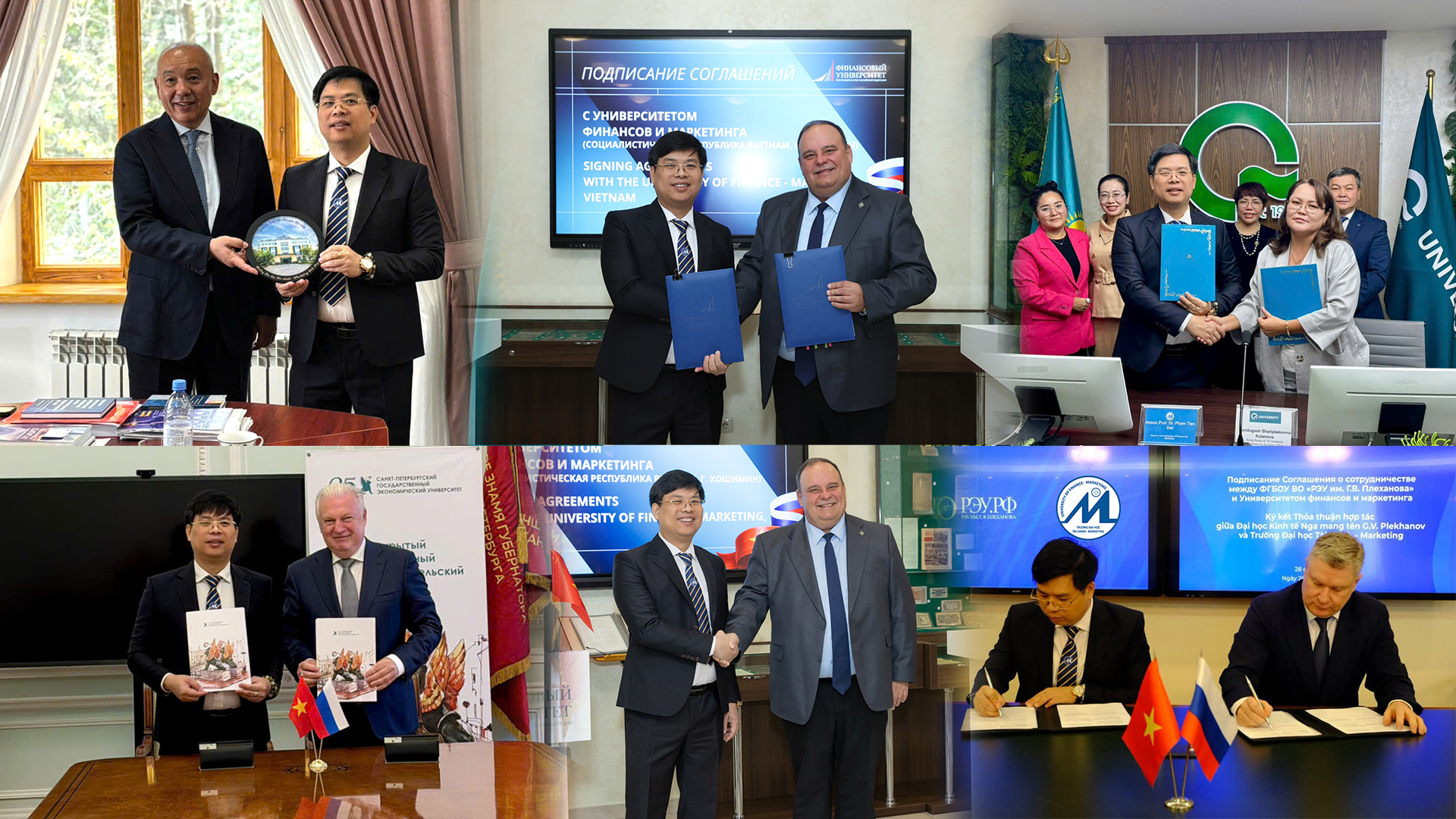
BrightUFM Expands Its International Academic Reach, Marking a New Milestone in Its Global Integration Strategy
The University of Finance – Marketing (UFM)’s international working visit to Kazakhstan and the Russian Federation from late September to early October 2026 not only expanded the University’s network of partners, but also reflected a clear shift in UFM’s approach to international cooperation: from establishing relationships to developing in-depth partnerships that are practical, implementable, and capable of creating direct value for education, scientific research, and learners.
Led by Assoc. Prof. Dr. Pham Tien Dat, President of UFM, the delegation held a series of meetings with universities and research institutes in Kazakhstan and the Russian Federation that have strong expertise in economics, finance, and management.
In Kazakhstan, UFM signed a cooperation agreement with Q University, opening a new channel of engagement with the higher education system in Central Asia in the areas of education, research, faculty and student exchange, and academic interaction. Establishing ties with Q University also contributes to diversifying UFM’s international partnership network and expanding its academic presence into a region with considerable potential for future cooperation.
A distinctive highlight of the visit was UFM’s effort to go beyond cooperation with higher education institutions by expanding its engagement with the Institute of Economics under the Science Committee of the Ministry of Science and Higher Education of the Republic of Kazakhstan. The two sides discussed cooperation in economic research, postgraduate education, and, notably, the possibility of joint research and policy advisory activities in areas such as the state budget, taxation, public finance, and economic and financial policy. This direction broadens the role of international cooperation from academic exchange to stronger links between scientific research, management practice, and policy consultancy, thereby enhancing UFM’s capacity to contribute to socio-economic development issues.
In the Russian Federation, UFM continued to broaden its cooperation with institutions whose academic strengths closely align with those of the University. UFM signed a cooperation agreement with the Saint Petersburg State University of Economics (UNECON) covering education, student and faculty exchange, and scientific research. Notably, Assoc. Prof. Dr. Pham Tien Dat also attended UNECON’s Opening Ceremony for the new academic year and its traditional anniversary celebration, where he expressed his hope that UFM would soon welcome UNECON students to Vietnam through exchange programs, bringing international cooperation closer to learners. U
FM subsequently established cooperation with Plekhanov Russian University of Economics, focusing on shared strengths in economics, finance, marketing, and management. The proposed areas of cooperation include education, scientific research, faculty and student exchange, academic conferences and seminars, and the development of joint research projects.
At the Financial University under the Government of the Russian Federation (Financial University – FU), cooperation advanced a further step. Beyond signing an institutional-level agreement, the two universities immediately held direct working sessions between their specialized faculties. Discussions focused on curriculum development, student and faculty exchange, scientific and technological projects, academic conferences, and joint publication of research outcomes. This approach reflects an increasingly clear orientation of UFM: international agreements should be translated into concrete programs, outputs, and measurable results.
Overall, the significance of the visit lies not in the number of meetings held or agreements signed, but in the increasingly diverse and in-depth structure of cooperation. From universities to research institutes; from education to research and policy consultancy; from institution-level agreements to direct faculty-level engagement; and from academic cooperation to expanded international experiences for students, these new connections are helping UFM build a broader ecosystem of international cooperation.
In its new stage of development, internationalization is no longer simply about expanding the list of partners. It is also about turning international knowledge, resources, and networks into drivers for improving the quality of education and research. From Kazakhstan to the Russian Federation, the recent visit can therefore be seen as a milestone in UFM’s evolving integration strategy: proactively seeking partners whose strengths complement its own, prioritizing substantive cooperation, and gradually deepening its participation in the global knowledge network.
Building on the foundations established during the visit, UFM’s aspiration to strengthen its international standing is being translated into new partnerships, implementable programs, and an increasingly open academic environment for lecturers, researchers, and students.
Hong Quan